What is VeloCMS? An honest review of the all-in-one blogging platform (2026)
VeloCMS is a hosted, all-in-one publishing platform: themes, a page builder, memberships, commerce, and AI tools in one subscription. Here's what it costs.
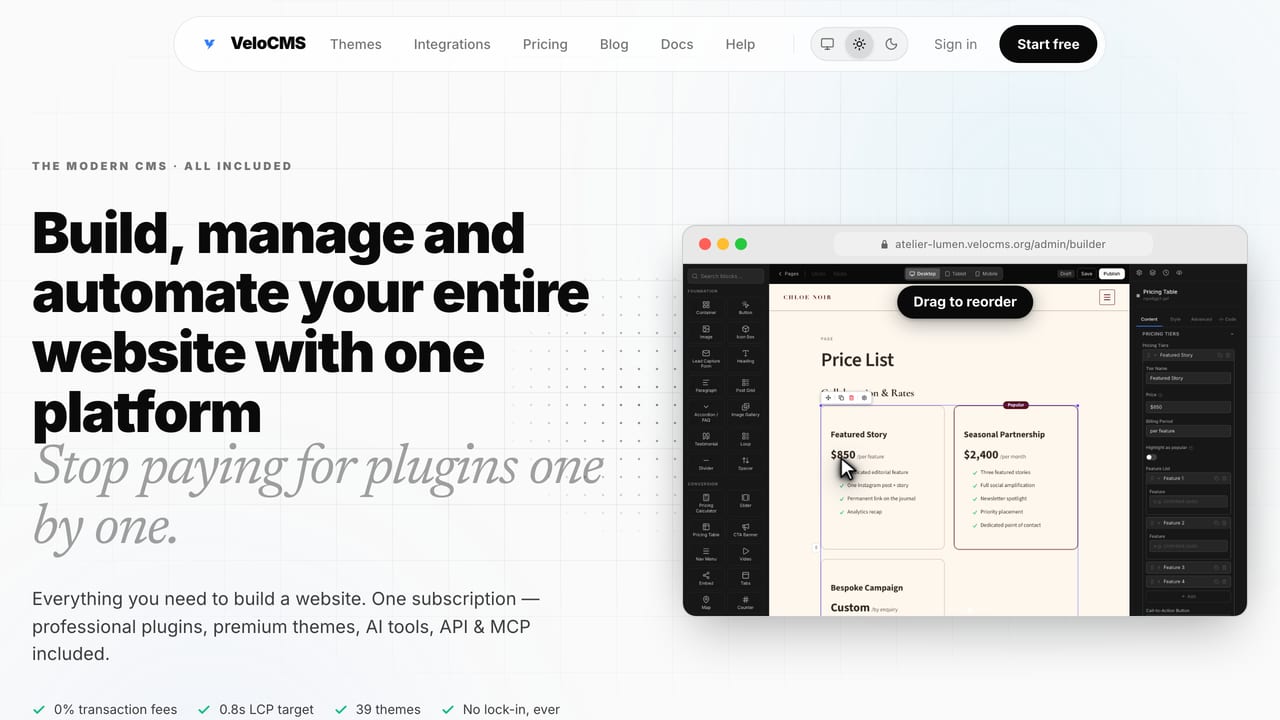
Question: What is VeloCMS, and is it worth switching to?
Short answer: VeloCMS is a hosted, all-in-one publishing platform. Themes, a visual page builder, memberships and paywalls, a newsletter, native commerce, AI writing and SEO tools, and migration importers all ship inside one subscription, with no plugins to buy or maintain. Plans are $9, $29 and $69 a month (less on annual billing), and every plan starts with a 14-day free trial, card required. The honest catch: it's managed SaaS only. There's no self-hosted core and no open third-party plugin ecosystem yet.
What is VeloCMS, exactly?
It's a content platform for people who publish for a living, or who'd like to. You sign up, pick one of 39 built-in themes (as of September 2026), connect a domain, and you already have a blog with an editor, a page builder, an email list, a paywall and a store attached to it. Nothing gets installed. Nothing needs updating by you.
The homepage states the thesis without much decoration: stop paying for plugins one by one. That's aimed squarely at the WordPress stack, where the software is free right up until you need SEO, caching, a page builder, forms, memberships and a newsletter, at which point you're quietly running six vendors on six renewal dates and hoping none of them breaks the other five.
Under the hood it's a server-rendered app on managed hosting behind a CDN, which is why the front page advertises an 0.8s load-time target instead of selling you a caching plugin. You never see any of that. There's no server to log into and no PHP to patch, which is the point and also, for some people, the objection.
Who is it for?
Solo creators and small publishing teams. The niche pages give the audience away pretty clearly: photographers, podcasters, restaurants, writers, developers, indie makers, agencies, plus roughly a hundred more specific ones. What they have in common is one person, maybe three, who writes, wants to charge readers or sell something alongside the writing, and has no interest in running infrastructure as a side hobby.
If you're a developer who wants root access and a repo you can fork, this is not your platform, and the section further down says so plainly.
What do you get without installing anything?
This is the part that decides whether the pitch holds up, so here's what's actually in the box today.
Writing and layout. A block editor for posts and a visual page builder with 70-plus blocks for everything that isn't a post: landing pages, pricing tables, galleries, embeds, forms. Themes number 39 (as of September 2026) and every one is included on every plan, not gated behind a tier.
Getting paid. Memberships and paywalls are native, and payments run through your own Stripe account with a 0% platform fee (Stripe's own processing cut still applies, as it does everywhere). Native commerce covers physical products with variants and shipping, digital downloads, event tickets, gift cards and online courses. The store speaks in your theme's visual language rather than looking like a bolted-on plugin.
Email. A newsletter with tag segmentation, sent to your own subscriber list, and no percentage taken from paid subscriptions.
AI, and where it's pointed. There's a Gemini-based writing assistant in the editor, alt-text generation, translation with hreflang handling, plus SEO scoring and an AI-search visibility score that grades a draft on how likely it is to be quoted by answer engines rather than only ranked by Google. Google Search Console performance sits right next to that score, so you see what a post actually did after publishing. You can bring your own AI key if you'd rather use your own quota.
Getting your stuff in. A WordPress migration wizard, a Squarespace XML importer, Webflow CMS collection imports, Substack and Ghost exports, and a Wix importer that reads your public URL directly so you never have to produce a backup file.
Automation. An official n8n node, publishing straight from Claude over MCP, Zapier and Make, plus a plain REST API and webhooks for anything else.
The unglamorous parts. Full Arabic and right-to-left support across the site and admin, GDPR tooling, two-factor auth and WebAuthn passkeys, instant on-site search, and domains you can either connect from any registrar or buy inside the dashboard.
What does VeloCMS cost?
| Plan | Monthly | Annual (per month) | Who it's for | |---|---|---|---| | Pro | $9 | $7.20 | One creator, one site | | Business | $29 | $23.20 | A team of five, bigger limits | | Agency | $69 | $55.20 | Five client sites, white-label, unlimited team |
Every plan starts with a 14-day free trial and a card is required upfront. You aren't charged until day 15, and cancelling before then costs nothing. Refunds run 14 days from the first payment, no questions asked. If you cancel later, the site drops to read-only rather than vanishing, and you can export or reactivate within 90 days.
The limits are worth reading before you commit. Pro includes 5 GB of storage, 5,000 subscribers, 1,000 AI calls a day, 100 AI translations a month and one site. Business raises those to 50 GB, 50,000 subscribers, 5,000 AI calls and unlimited translations. Agency includes five sites with extras at $9 a month each, and lifts the storage and subscriber caps entirely.
Where VeloCMS falls short
A review that only lists features isn't a review, so here are the four things most likely to disqualify it for you.
There's no self-hosted version. The application is proprietary and managed SaaS only: no source access, no server, no fork. The plugin SDK and CLI are MIT-licensed on npm, but the platform itself is not. If your requirement is "I must be able to move this onto my own box," VeloCMS fails that requirement today and there's no roadmap date to point you at. Your content isn't hostage (posts, members and settings export as JSON, CSV or Markdown from the dashboard whenever you like), but the software is not yours.
There's no third-party plugin or theme marketplace yet. The developer program is written up publicly and clearly marked as not open. Every plugin and theme you can use today is first-party. That's a genuine strength for reliability and a genuine weakness for coverage: if your business depends on one specific WordPress plugin, nobody can build you the equivalent right now.
Importers cover platforms, not folders. WordPress, Wix, Squarespace, Webflow, Substack and Ghost all have their own path in. A Markdown archive from Jekyll or Hugo doesn't, so those posts go in one at a time. The Wix importer also has a known soft edge: pages built almost entirely from client-side scripts can arrive thinner than expected, and Wix's own RSS feed carries no images, so imported drafts deserve a scroll-through before you publish them.
There's no free plan. The trial is free, the platform isn't. If you want to publish indefinitely at zero cost, this is the wrong product and Substack or a free WordPress.com site is a better answer.
If you want the side-by-side against specific tools rather than the overview, the compare page puts VeloCMS next to Substack, Ghost, Squarespace and Medium, and the WordPress comparison covers the plugin-tax argument in detail. Current plan pricing lives on the pricing page.
Frequently asked questions
Is VeloCMS free?
No. There's no free plan. Every plan starts with a 14-day free trial that requires a card upfront, and you're charged on day 15 unless you cancel first. Paid plans are $9, $29 and $69 a month, with a 20% discount on annual billing.
Can I self-host VeloCMS?
No. VeloCMS is proprietary, managed SaaS with no self-hosted core and no source access. The plugin SDK and CLI tooling are MIT-licensed and published on npm, but the platform itself isn't open source. Your data stays portable either way, since posts, members and settings export as JSON, CSV or Markdown at any time.
Does VeloCMS take a cut of my subscription or product revenue?
No. Memberships, paid newsletters and store sales run through your own Stripe account at a 0% platform fee. Stripe's normal processing fee (roughly 2.9% plus $0.30 per transaction) still applies, the same as it would on any platform.